
Dear LPers,
A panel discussion was organised for the 18th International Conference on Logic Programming and Non-monotonic Reasoning (LPNMR 2026), having as panelists the professors Chitta Baral, from Arizona State University; Stefania Costantini, from the University of L’Aquila; Thomas Eiter, from TU Wien; Gerhard Friedrich, from the University of Klagenfurt; Francesco Ricca, from the University of Calabria and Torsten Schaub, from the University of Potsdam.
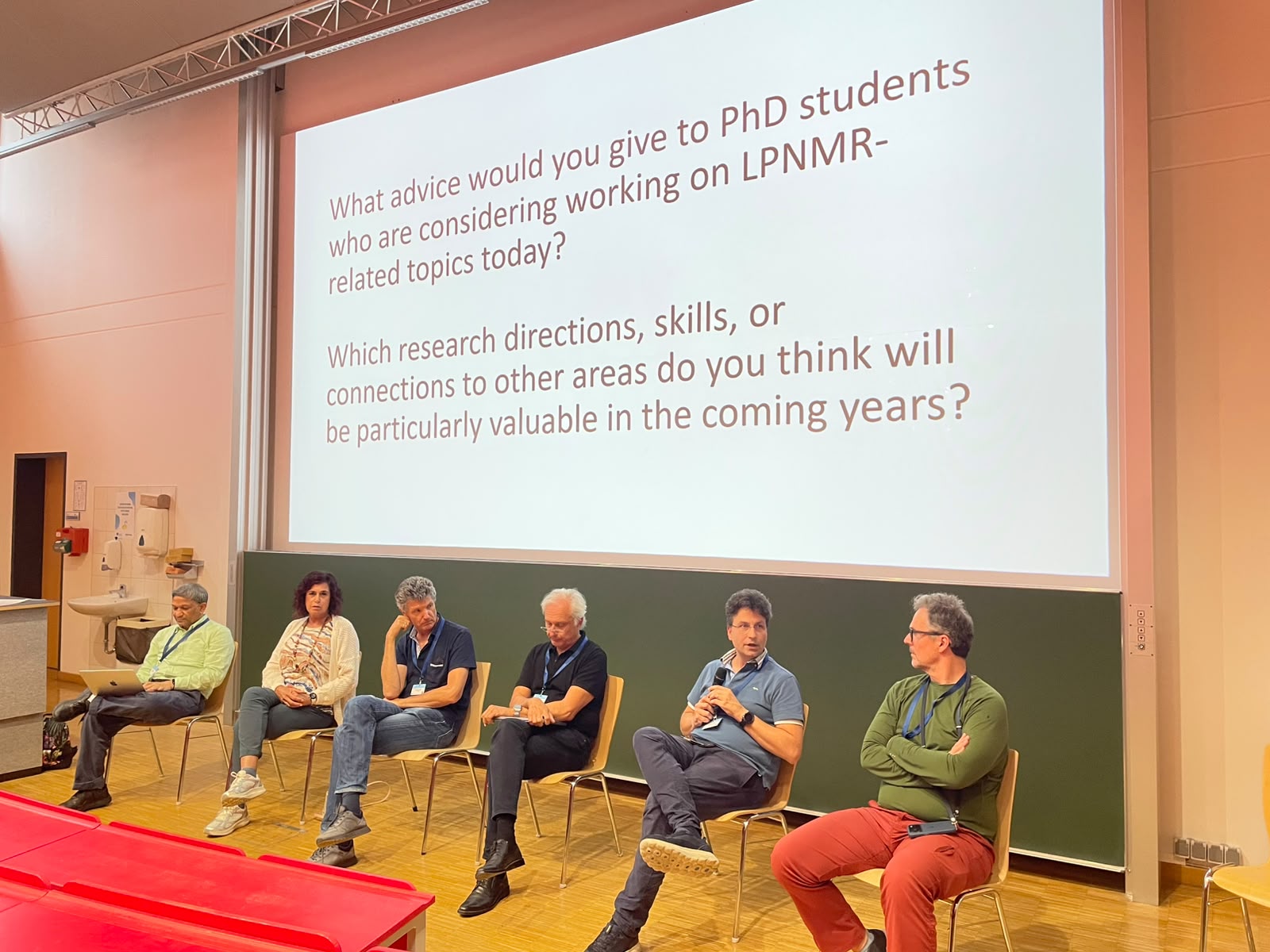
The discussion addressed questions regarding the past, present and future of the community and included advice for the next generation of researchers; in particular, it focused on the opportunities and challenges in industrial applications and on the relation to sub-symbolic systems, such as LLMs and language agents.
Having recently joined the ALP board as web editors, we would like to take this chance to introduce ourselves to the community by briefly collecting here the main points discussed and sharing our thoughts on interesting insights for our community.
The most important breakthrough in LPNRM
The panel discussion opened with the reflection on the most important breakthrough in LPNMR and the reason for its lasting impact. Overall, two main aspects emerged, namely, the development of solid semantic foundations and the presence of effective implementations.
On one hand, stable model semantics, its connections to intermediate logics, like here-and-there, and the optimisation statements, provide a strong and expressive theoretical basis. On the other hand, solvers such as SMODELS represented a turning point by allowing for implementing these ideas. Subsequent developments, such as DLV and clingo, further expanded the applicability of declarative modeling. These systems allowed for expressing complex problems in a compact and natural way, finding (optimal) solutions which, until then, were unavailable.
Industrial applications
Although sub-symbolic AI approaches might be more visible than LPNMR systems in industry, this does not imply a lack of industrial use of the latter. Companies are primarily concerned with solving the problems they address, rather than applying a specific technology; thus, they may welcome logic-based solutions, especially when they deliver accountability and verification. Moreover, ASP and constraint-based technologies have demonstrated substantial benefits in real-world applications, reducing costs while improving the speed and quality of solutions [1]. Apart from the direct experience of researchers within the community, the Potassco mailing list can provide another indication of the demand of these systems since a considerable share of its users comes from outside our research community and is actively interested in applying this technology.
Nevertheless, it was pointed out that the direct application of existing LPNMR systems might cover only part of the broader range of problems the community would like to address. To extend the potential applicability, dedicated effort is needed and few potential areas were identified.
First, the lack of formal specifications was recognized as a possible issue. In real applications, the problem specifications can be initially incomplete, ambiguous, or not clearly defined. Thus, before using a solver, considerable work is needed to obtain a clear picture. It was also emphasised that tackling this issue brings additional benefits to the companies as formalizing a problem can itself create lasting value. By making assumptions, constraints, and domain knowledge explicit, a logic-based specification can serve as a reusable and maintainable knowledge asset, independently of the particular solving technology employed.
Another important aspect concerns the integration of LPNMR systems with actual industrial workflows and other AI paradigms. For example, through components that integrate naturally with machine learning frameworks such as PyTorch. On a similar note, making LPNMR systems more accessible to final users could increase and simplify their applicability. Both of these ideas would require consistent software engineering efforts, which was consequently identified as key and highly beneficial for the community.
LLMs and language agents
Next, it was discussed what challenges and opportunities arise for the LPNMR community with the current AI status, especially with respect to LLMs and language agents.
Building on this earlier discussion, one important direction consists of exploring deeper forms of neuro-symbolic integration. Language agents can interact with external tools to perform operations, and LPNMR systems can be a valuable option for this. However, the more interesting research challenge is to investigate deeper forms of neuro-symbolic integration, in which learning and reasoning interact rather than forming a simple pipeline.
Beyond integration, several panelists emphasized that the close relationship between theoretical foundations and practical implementations remains a distinctive strength of the LPNMR community. This combination allows us to address problems where LLMs cannot be applied because of their lack of guarantees on providing a reliable answer. Verifying solutions quickly generated by LLMs can have high cost and bring several difficulties. On the other hand, LPNMR systems can have a sound verification process and it is possible to obtain an explanation for their reasoning. The discussion also highlighted the potential contribution of non-monotonic logic to applications involving regulations and ethical requirements, where general rules coexist with exceptions and implicit assumptions. In these settings, logic programs can represent reusable modules that capture domain knowledge, including normative and deontic ones.
Lastly, another interesting perspective concerned the potential impact of LLMs on the reasoning side. During the discussion, it was observed that if a problem is described very clearly and comes together with objective measures, then an LLM might generate problem-specific algorithms that could even outperform general-purpose encodings. These results could open new research directions for the community, making knowledge representation even more important than before. Indeed, if obtaining problem-specific algorithms becomes easier, the need to soundly verify the solution obtained is even more crucial and greater emphasis can go on the representation of the problem itself. LLMs may help in bridging the gap between informal descriptions expressed in natural language and the formal specifications required by LPNMR systems. Still, obtaining sufficiently precise and reliable representations remains a fundamental challenge.
Advice to young researchers
At the end, the discussion moved on advice that could be given to young researchers that work or want to work in LPNMR-related topics. Here, the importance of pursuing research questions with genuine interest was emphasized. The completion of a PhD requires years of work, and to develop a proper understanding of the field takes time. Although LLMs can speed up certain steps these days, the time spent acquiring new concepts has a hidden value that cannot be measured but which is crucial for a successful PhD (and in other contexts too).
Pursuing pure theoretical research questions was suggested; however, exploring applications based on sound theoretical foundations was also highlighted, especially if a student would like to have an industrial career. Several panelists suggested having a broad perspective and looking for connections with other areas. Promising directions include integrating logic with other fields, such as CP or Machine Learning, or improving the modularity and accessibility of existing reasoning technologies. Such developments could also make it easier for new researchers to contribute to established LPNMR systems/solvers. As mentioned before, these efforts may take time and commitment, but successful systems can be widely adopted and have a considerable influence.
Editor’s discussion
The discussion provided a valuable opportunity to reflect on the current state and future directions of LPNMR, bringing together different perspectives. Here, we discuss some of the topics that came up and offer our perspective on their implications and potential research directions for the community.
Moving from a research prototype into a software that can be used in production requires considerable effort and we see generative AI-assisted programming as an opportunity to help reduce this gap. Of course, relying too heavily on these tools introduces risks and therefore strong software engineering skills are fundamental. Engineers (or researchers with a software engineering background) are particularly well placed with respect to this point, since they can better assess the quality and robustness of the generated code. On top of that, we would like to highlight a concept that emerged during the discussion, namely the importance of acknowledgement from our community of works grounded in usability and explainable AI foundations.
Regarding possible opportunities for LPNMR systems with generative AI, we see KR languages playing a potential role for structuring prompts and guiding the reasoning of LLMs. Indeed, they are expressive enough to remain understandable and easy to modify by humans, yet precise enough to be translated into well-defined, verifiable specifications. Looking further ahead, such representations might also help address hallucinations by making it possible to check alternative reasoning paths against available knowledge, formal specifications, and explicit constraints. Despite the open challenges, this could be a promising research direction where LPNMR could contribute to making AI systems more reliable and verifiable.
Lastly, the discussion also raised the question of how declarative reasoning could be introduced earlier in education, potentially even before students become familiar with imperative programming paradigms. This has been tested with Prolog and it could be interesting to extend it to languages such as Answer Set Programming (ASP). One possible approach is to build on the familiarity of younger students with mathematical notation. Introducing younger students to declarative paradigms could offer them a different perspective on problem-solving that could be useful for their future in academia or industry.
We hope you’ve found some interesting ideas in this post. If you’d like to add anything, we look forward to reading your comments 🙂
Alice Tarzariol & Brais Muñiz
[1] A. Falkner, G. Friedrich, A. Haselböck, G. Schenner, and H. Schreiner. Twenty-five years of successful application of constraint technologies at siemens. AI Magazine, 37(4):67–80, 2016. doi: 10.1609/aimag.v37i4.2688.